
For a long time, scientists believed that the human brain was largely fixed after childhood. The general understanding was that the brain developed during our early years, reached maturity and gradually lost its ability to change as we grew older.
Today, we know that this picture was incomplete.
The human brain is remarkably adaptable. It continuously responds to new experiences, learning, challenges and even the environment around us. Whether we are learning a new language, developing a skill, navigating an unfamiliar city or recovering from an injury, our brains are constantly adjusting and reorganising themselves.
This ability is known as neuroplasticity, and it is one of the most fascinating discoveries in modern neuroscience.
What Is Neuroplasticity?
Neuroplasticity, sometimes called brain plasticity, refers to the brain’s ability to modify its structure, connections and functions in response to experience.
Our brains contain billions of nerve cells called neurons. These cells communicate with one another through specialised connections known as synapses. Together, they form complex networks responsible for everything from memory and attention to movement, emotions and decision making.
Whenever we learn something new or repeatedly practise a particular activity, the communication between certain neurons can change. Some connections become stronger, others become weaker and new connections can develop.
Think of it as a constantly evolving network. The more frequently certain pathways are activated, the more efficiently the brain can use them. Meanwhile, connections that are rarely used may gradually become less prominent.
This is one reason why repetition and practice are so important for learning. Whether you are learning to play an instrument, improving your memory or developing a new habit, your brain is adapting to the experience.
Importantly, neuroplasticity is not limited to childhood. Although the developing brain has a greater capacity for certain types of change, research confirms that the adult brain retains the ability to adapt throughout life.
The Science: Can Experiences Actually Change Your Brain?
One of the most interesting aspects of neuroplasticity is that researchers have been able to observe physical changes in the human brain associated with learning and experience.
A particularly fascinating example comes from a study of London taxi drivers.
What London Taxi Drivers Can Teach Us About the Brain
In London, becoming a licensed taxi driver requires extensive knowledge of the city’s streets, landmarks and routes. Trainees traditionally spend several years studying thousands of streets and learning how to navigate the city without relying on GPS.
Researchers at University College London studied this process to understand whether such demanding learning experiences could influence the physical structure of the adult brain.
The study, published in 2011 in the journal Current Biology, followed trainee taxi drivers over several years. Using brain imaging, researchers found that those who successfully completed their training showed an increase in grey matter volume in the posterior hippocampus, a region strongly associated with spatial memory and navigation.
Interestingly, the same changes were not observed in trainees who did not qualify.
The findings provided compelling evidence that intensive learning can be associated with measurable structural changes in the adult brain.
In other words, the brain was not simply storing information about London’s streets. It was physically adapting to the demands of learning and using that information.
Learning to Juggle and the Changing Brain
Another interesting area of research involves something much simpler: juggling.
In a well-known study published in Nature in 2004, researchers examined whether learning a new motor skill could produce measurable changes in the adult brain.
Participants who had no previous juggling experience were trained to learn a three-ball juggling routine. Brain scans revealed changes in grey matter in regions involved in processing visual motion after the training period.
When some participants stopped practising, these changes partially reversed.
This was an important observation. It suggested that the brain’s physical structure is not permanent or static. It can adapt in response to new skills and experiences, while some of those changes may diminish when the activity is no longer practised.
Research involving older adults has also demonstrated that the ageing brain retains some capacity for experience-dependent structural change. In other words, learning something new does not become irrelevant simply because we get older.
What Influences Neuroplasticity?
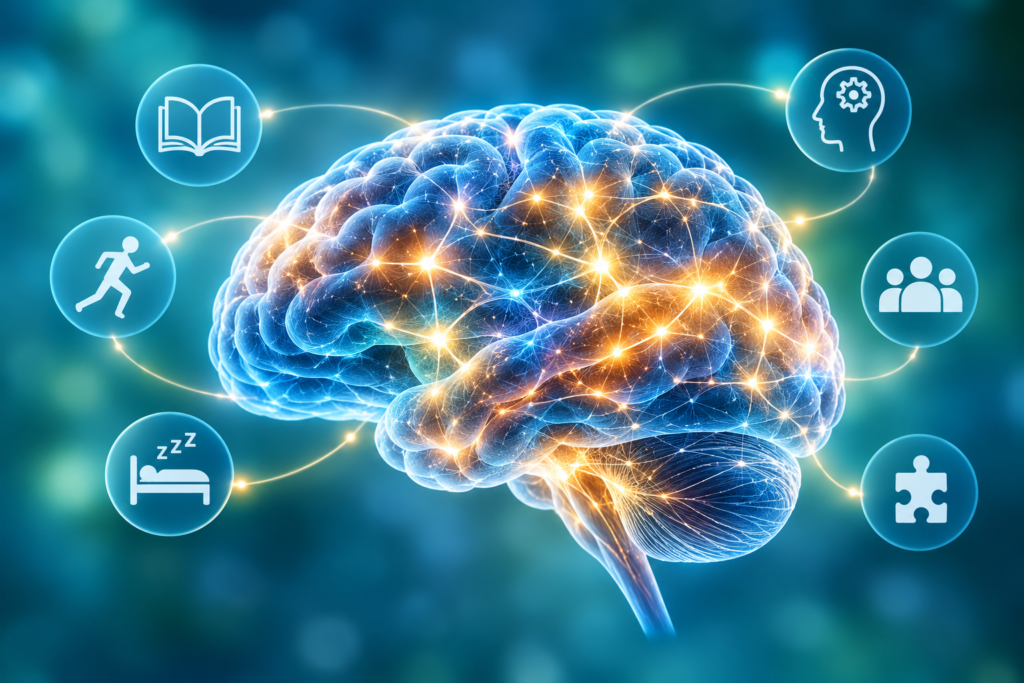
Neuroplasticity is a natural process, but it is influenced by how we live, learn and interact with our surroundings. Several factors have attracted particular attention in neuroscience research.
1. Continuous Learning
Learning challenges the brain to process new information, establish associations and develop new ways of thinking. Reading, learning a language, playing a musical instrument or exploring unfamiliar subjects can all engage different neural networks.
The key is to expose the brain to experiences that require active engagement rather than simply repeating what is already familiar.
2. Physical Activity
Exercise does more than benefit physical health. Research suggests that physical activity can also support brain health and neuroplasticity.
Aerobic exercise, in particular, has been associated with increased levels of brain-derived neurotrophic factor (BDNF), a protein involved in neuronal survival, synaptic function and the processes that support learning and memory.
Physical activity also supports blood circulation, helping deliver oxygen and nutrients to the brain.
3. Quality Sleep
Sleep plays an important role in learning and memory. During sleep, the brain processes and consolidates information acquired throughout the day.
Research suggests that sleep supports the stabilisation of newly formed memories and the regulation of synaptic connections. Consistently insufficient sleep can interfere with these processes, making it harder to learn, concentrate and retain information.
4. Mental and Social Engagement
Our brains benefit from meaningful engagement with the world around us. Conversations, social interactions, problem solving and mentally stimulating activities expose the brain to different types of information and challenges.
These experiences engage multiple cognitive processes, including attention, language, memory and emotional processing.
Neuroplasticity and Healthy Ageing
One of the most encouraging aspects of neuroplasticity research is its relevance to healthy ageing.
Although certain aspects of brain plasticity become less pronounced with age, the ability to learn and adapt does not simply disappear. Older adults can continue acquiring new skills, strengthening existing abilities and developing new neural connections.
A 2024 review published in Brain Plasticity, examining research from 2017 to 2023, highlighted the roles of exercise, learning and environmental enrichment in supporting brain plasticity throughout life.
The findings reinforce an important idea: maintaining an active and stimulating lifestyle can contribute to the brain’s ability to adapt as we age.
This does not mean that learning a new skill or exercising can prevent all age-related cognitive changes. Nor does neuroplasticity guarantee protection against neurological conditions. However, it provides a scientific foundation for understanding why continued mental and physical engagement matters.
Your Brain Is Still Learning
Perhaps the most valuable lesson from neuroplasticity is that the brain is not a finished product.
Every new experience presents an opportunity for the brain to process information, adjust its connections and adapt to changing demands. Learning does not end when formal education finishes, and the ability to develop new skills does not belong exclusively to younger generations.
From taking a different route home to learning a musical instrument, engaging in physical activity or challenging yourself with something unfamiliar, everyday experiences can contribute to keeping the brain active.
The science is still evolving, but one thing is clear: our brains are far more adaptable than we once believed.
A healthy brain is not simply one that remembers what it has learned. It is also one that remains capable of learning something new.